

Seneca Falls, Convention Days 2026

Thursday, July 16, 2026 – It’s my mother’s 113th birthday and I’m spending the afternoon at the 1816 Quaker Meetinghouse in Farmington, NY because it was an exciting place to be in the 1840s-1850s. And because it will featured in my second novel The Mind and the Star. They are restoring it as a museum. I try the back door. It is open! I walk around inside where pews and old boards are all tossed around in a mess. The windows are all boarded up, like they were when the radicals came in 1850. I also find a Quaker cemetery and markers showing where the Underground Railroad was. Then I drive 30 miles to Seneca Falls, where I check into the Gould Hotel, an old hotel right next to the National Park Visitor Center.

Friday, July 17, 2026 – First stop is Elizabeth Cady Stanton’s house, where she was living when she got the idea to hold the first women’s rights convention in 1848. They only had 10 days to plan it because the Quaker minister Lucretia Mott would only be in town then.


Today, reenactors of Elizabeth Cady Stanton (ECS) and Frederick Douglass (FD) enthrall us with stories. They remind us that it was 72 years from the Declaration of Independence to the Seneca Falls convention with its Declaration of Sentiments, and then 72 years from then until the passing of the 19th Amendment when women got the right to vote. FD quotes Sojourner Truth, when a young girl asked her if she could read, she said, “I don’t read little things like words. I read big things like men.” ECS regales us with stories of how hard it was to stand up to the abuse, name-calling, thrown objects, buildings being burned, hot pepper, and pigs. As I sit listening to them, I am realizing the real Elizabeth Cady Stanton and Susan B. Anthony sat together planning in this very room. Susan took care of the ECS’s three kids while Elizabeth wrote. In this very room.
The house is part of the national park, and I join a ranger tour of the canal locks nearby. It was the building of these canals that led to the growth of the area from 1820 onwards.

I go to the community expo at the National Park Visitor Center hoping to connect with people. The picture above is the wall next to the visitor center with the Declaration of Sentiments and the names of the signatories. I talk with the Friends of the Women’s National Park at Seneca Park and tell them about We Did It For You! We develop ideas for screenings and staged performances, and exchange contacts. Then I discover a woman standing next to me is the historian Judy Wellman from the 1816 Quaker Meetinghouse, the very person I was hoping to meet. She is very excited about my manuscript and the stories I want to include.
There’s a lecture by a historian Linda Frank on the family of Henry Stanton, the husband of Elizabeth. And then we read the Declaration of Sentiments one by one – the document that emerged from that convention in 1848 which 100 people signed. It addressed issues about property, divorce, custody, employment, education, dependency. And suffrage. What I learn is that the Married Women’s Property Act passed in New York in 1848. And ECS received the house in Seneca Falls in 1847. This got ECS thinking that since she was a legitimate property owner now in her own right, she deserved the right to vote.
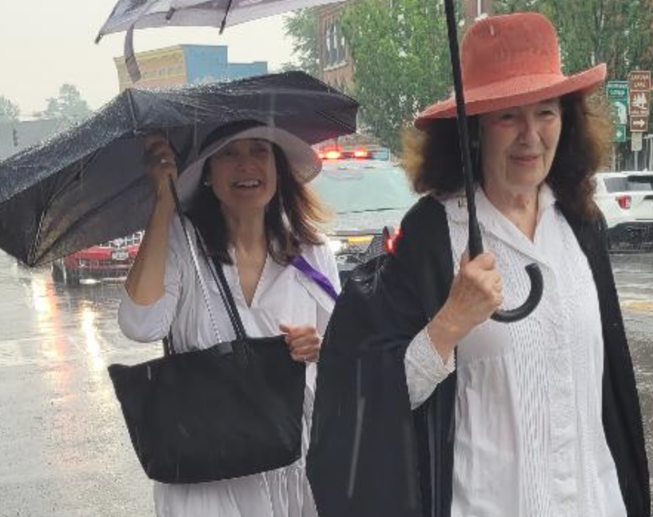
Saturday, July 18, 2026 – It has become a tradition since 1849 to recreate ECS’s walk from her house to the Wesleyan Chapel where the convention was. I join Coline Jenkins (ECS’s great-great-granddaughter, right in picture), Fredie Kay (director, Massachusetts Women’s History Center, left in picture), and lots of other people to walk in the rain. We have a police escort.


We pass sculptures of ECS meeting Susan B. Anthony (which happened after 1848), and of Laura Cornelius Kellogg, Harriet Tubman, Sojourner Truth, and Martha Coffin Wright in the Ripples of Change sculpture.

At the chapel, we hear from the FD and ECS reenactors at the opening ceremony.

I attend a luncheon where I meet an original Rosie the Riveter (Mary Masciangelo, in picture on left) and Gloria Peek (not pictured), the first women’s boxing Olympics coach. Both are incredible role models. Then I watch a film Without a Whisper about Dr. Sally Roesch Wagner (whose research I used about the Iroquois and women from upstate New York). I go to a talk by Laura Free, another historian about the unfulfilled promise of ‘all men are created equal’. We read the names of all the signers of the Declaration of Sentiments. I talk to the Superintendent of the National Park about We Did It For You! She loves the idea of doing screenings.

Sunday, July 19, 2026 – I go to a power luncheon of about 20 women, the real movers and shakers behind the convention days. When Fredie laments not having had a chance to visit the National Women’s Hall of Fame, the director of operations Julie Bazan, raises her hand and says, “I’ve got the keys!” She promises us a tour.
The woman from AAUW Rochester, who helped organized the convention days, buys a copy of We Did It For You! And promises to show it in September. The Susan B. Anthony reenactor wants to come to our screenings. The owner of a theatre wants to do some stage performances. I talk to someone else about doing the workshop and staged readings. After the luncheon, Fredie and I get the private tour as promised of the Hall of Fame. All in all, it was amazing. Many connections, learned so much.


Comments